


If you live in a fast-paced city like New York or Boston, your time is your most valuable asset. You’ve probably spent months: maybe years: tapping away at a green bird on your phone, hoping that “the apple is red” will somehow translate into a fluid conversation at a tapas bar in Madrid or a business meeting in Mexico City.
But let’s be honest: apps don’t talk back. And while you might be looking for Spanish Classes in New York or Spanish Classes in Boston to finally get serious, the thought of commuting across Manhattan or fighting traffic on the Mass Pike after a long workday is enough to make anyone hit “snooze” on their language goals.
At HOLA Spanish Centre, we’ve seen thousands of students in North America make the jump from passive “app users” to confident Spanish speakers. Before you sign up for the first class you find on Google, here are the 5 essential things you need to know to ensure you actually reach fluency.
1. Live Human Interaction is Non-Negotiable
The biggest mistake beginners make is thinking they can learn to speak in a vacuum. You can memorize 2,000 words on an app, but the moment a native speaker asks you a question at normal speed, your brain might freeze.
Why? Because language is a social skill, not a data-entry task.
- Real-time feedback: When you’re in a live class, your instructor catches your pronunciation errors instantly. You won’t spend six months saying “llamo” incorrectly because a human corrected you in week one.
- Dynamic listening: You need to hear different accents, speeds, and tones.
- Confidence building: Speaking Spanish in front of others is a hurdle you have to clear. Live classes provide a safe, supportive space to make mistakes and get over the “fear of sounding silly.”
If you are looking for Spanish Classes in New York, don’t just look for a curriculum: look for live interaction.
2. Small Class Sizes Make or Break Your Progress
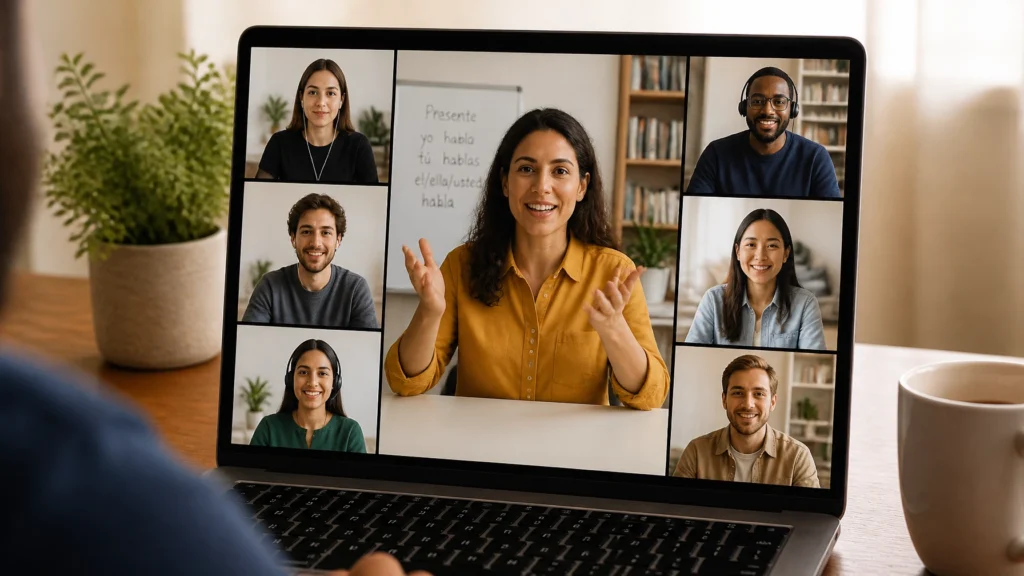
In a massive city like Boston, some language schools pack 20 or 30 people into a room (or a Zoom call). In those settings, you might get to speak for a grand total of two minutes per hour. That’s not a class; that’s a lecture.
At HOLA Spanish Centre, we keep our group classes small: typically around 12 students max. This is the “sweet spot” for several reasons:
- Personalized Attention: Your instructor actually knows your name, your strengths, and exactly where you’re struggling.
- More “Air Time”: With fewer students, you are constantly prompted to speak, answer questions, and engage in dialogues.
- Community: You get to know your classmates. Many of our students in New York and Boston find that their online cohorts become a vital part of their weekly social routine.
3. Native Instructors Bring the Culture to Your Living Room
Learning Spanish isn’t just about verb conjugations; it’s about understanding the soul of the language. Whether you’re in the Back Bay or Brooklyn, you want an instructor who can explain the difference between how they say “cool” in Colombia versus Spain.
All of our instructors are native Spanish speakers from various Latin American countries. This provides you with:
- Authentic Accents: You learn how people actually talk, not just the “textbook” version.
- Cultural Insider Tips: Want to know the best way to navigate a market in Peru or the etiquette for a dinner party in Argentina? Our teachers live and breathe these cultures.
- Nuance: They can explain the subtle “vibe” of words that a computer program simply can’t grasp.
| Feature | Language Apps | Large Physical Classes | HOLA Live Online Classes |
|---|---|---|---|
| Interaction | None (Static) | Limited (Too many people) | High (Small groups) |
| Feedback | Automated/Robotic | Delayed | Instant & Human |
| Commute | 0 mins | 45-60 mins | 0 mins |
| Accountability | Very Low | Moderate | High (Fixed Schedule) |
4. The “Commute Killer”: Why Live Online Beats In-Person
Let’s talk about the logistics of Spanish Classes in Boston or New York. Between the subway delays and the unpredictable weather, getting to a physical location can turn a 1-hour class into a 3-hour ordeal.
Live online classes offer the perfect middle ground. You get the high-quality, face-to-face instruction of a premium language school, but you can join from your desk in the Financial District or your couch in Cambridge.
- Consistency is Key: You are much more likely to stick with your 6:00 PM class if you don’t have to travel to get there.
- Energy Levels: After a long day of work, you can grab a coffee (or a glass of wine!), open your laptop, and be “in class” in 30 seconds.
- Quality Without Borders: You aren’t limited to the schools in your immediate neighborhood. You can choose the best program regardless of where their physical office is located.
5. A Proven, Structured Path (Beyond “Survival Phrases”)
A lot of local “conversational” classes lack a clear roadmap. You might spend one week talking about food and the next talking about the weather, but you never actually learn how the language works.
For long-term success, you need a structured curriculum. At HOLA, we use our own proprietary Hola Spanish workbook and provide access to online interactive modules that complement your live sessions.
You need a clear progression from Beginner 1 through to Advanced, so you always know exactly what you’ve mastered and what’s coming next. This structure is what turns “I know a few words” into “I am functionally bilingual.”
Practice Tips: How to Excel in Your First 6 Weeks
Moving from passive learning to active speaking is a transition. Here’s how to make it stick:
- The 15-Minute Rule: On days you don’t have class, spend just 15 minutes with your HOLA workbook. Consistency beats intensity every time.
- Speak Out Loud (Even When Alone): Narrate your day in Spanish. “Estoy haciendo café” (I am making coffee). It trains your mouth muscles to form the sounds.
- Change Your Phone Language: It’s a “sink or swim” tactic, but it forces you to learn high-frequency words like configuración and mensajes fast!
- Listen to Podcasts: Try “Spanish Observed” or “Coffee Break Spanish” during your commute. It keeps your ears tuned to the rhythm of the language.
Ready to Finally Speak Spanish?
Whether you’re preparing for a trip to Patagonia, looking to connect with Spanish-speaking family, or boosting your career in a global city, the best time to start was yesterday. The second best time is now.
Don’t settle for another year of “just playing with the app.” Join a community of motivated learners and expert native instructors who are dedicated to your success.
👉 Explore our upcoming Online Spanish Courses here!
We can’t wait to see you in class!